
Introducing: the Agricultural Renaissance Community
A new model for sustainable, large-scale mixed-use development
Why propose alternative developments?
Nature abhors a vacuum. The communities that have been targeted for heavy industrial development do need revitalization and investment. But these heavy industrial projects are not what they need.
In order to protect these sites, and Michigan's water and land at large, we must help our policymakers, legislators, developers, and investors understand that there is another path. More than that: we must map out that path and actively advocate for it.
In collaboration with grassroots communities across the state and based on copious scientific and market research, we've developed an alternative model for large-scale economic development which we call the Agricultural Renaissance Community (ARC)..
What is the ARC?

The ARC is a large-scale, mixed-use model for development designed to improve local economies, ecologies, and communities, without major subsidies or loss of local control.
Instead, ARC developments are driven by the needs and desires of local community members, and they generate both affordability and overall profitability using simple land management techniques and the free market.
Inspired by the feedback of Michigan’s grassroots communities and confirmed by cusping academic research, this model could not only create jobs, but re invigorate entire local economies.
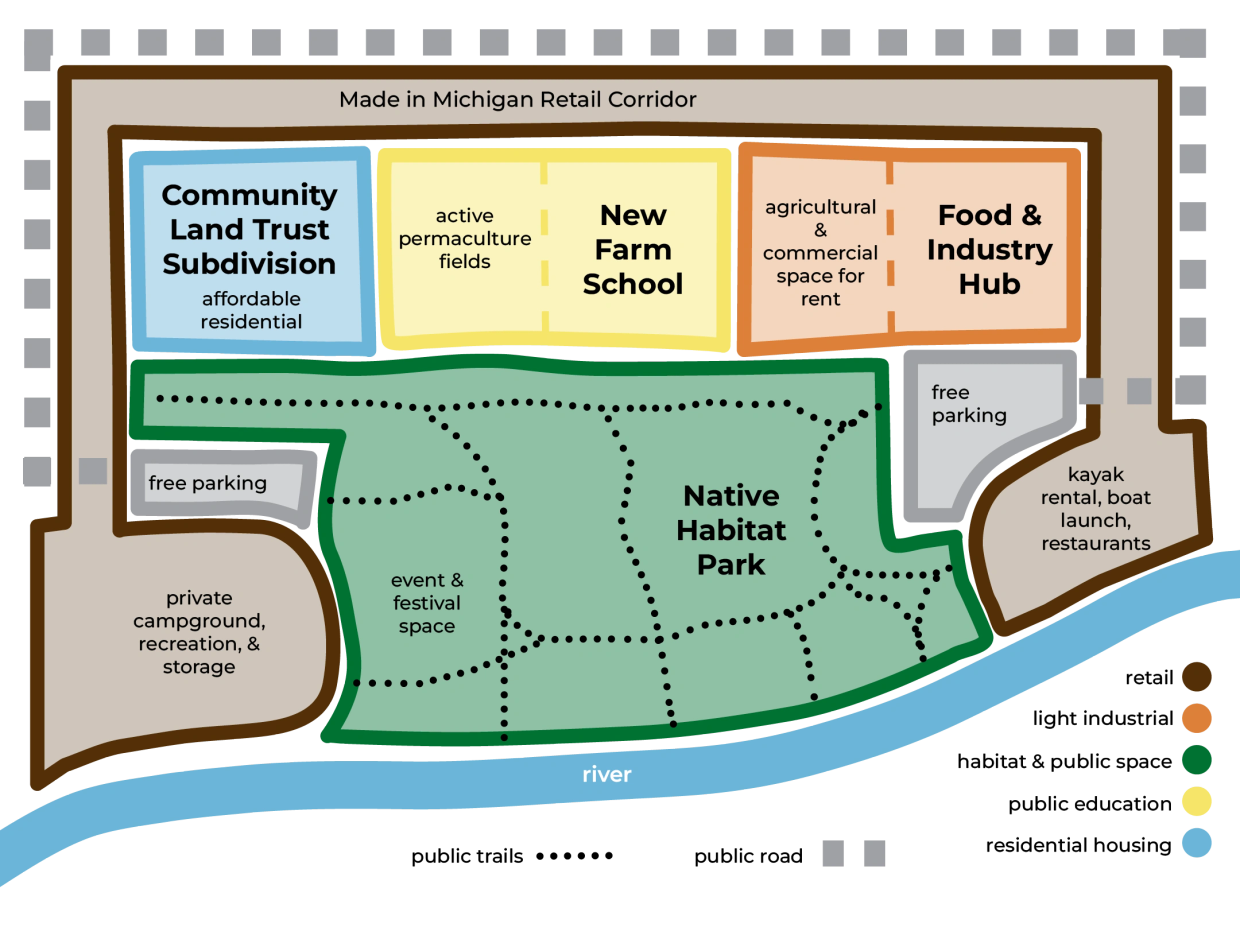
Spanning 100 to 2,000 acres, the ARC model has five zones which each address a different (but related) need in the local community:
1) Light Industry
Which brings truly quality jobs, good wages, and more money flowing into the local economy. Top recommendations: food hubs, fiber mills, hempcrete manufacturing industrial wool processing, and other activities supportive of local and regenerative agriculture.
2) Housing
Which is actually affordable for local residents, using a Community Land Trust model for homeownership and sustainable, energy-efficient building practices.
3) Retail & recreation
Which supports local industry and natural resources, including an anchor grocery local farm market, Michigan-made product retail, scenic restaurants, and recreation tourism such as private campgrounds and kayak rentals.
4) Education
Which uses evidence-based Montessori and project-based learning models, combined with hands-on permaculture farming and outdoor learning spaces. Scalable to community needs, from a Learning Center resource for area schools to a full K-12 public school.
5) A Habitat & Community Park
Which provides a free resources to the community with public trails, a refuge for wildlife, and space for large-scale festivals, public gatherings, and other community cultural events which stimulate the local economy and improve local sense of place.

Have you subscribed?
Get the latest news and action items by subscribing to our newsletter.